

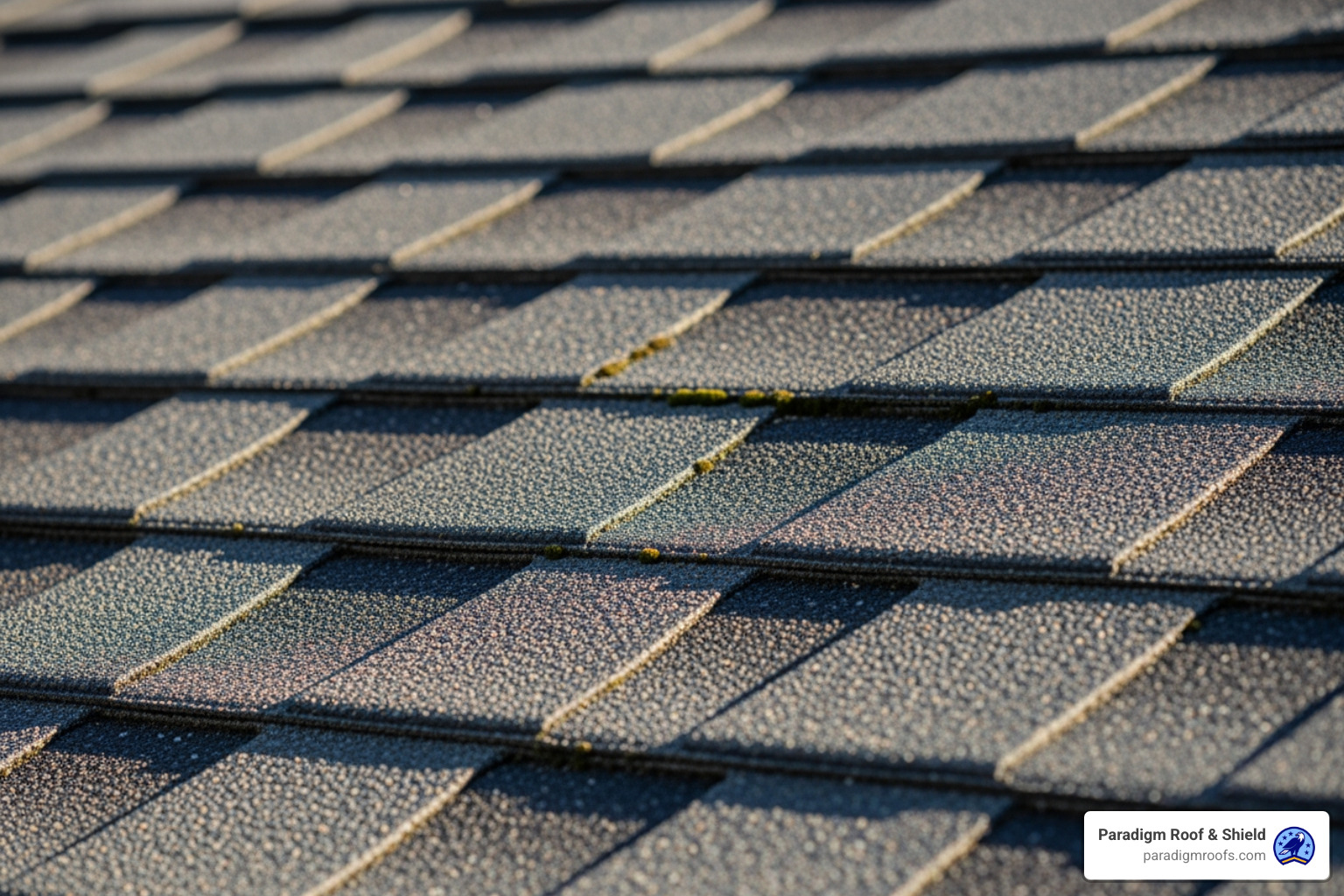
Understanding What “30-Year Shingles” Really Promise
30 year shingles don’t actually last 30 years in most real-world conditions. Here’s what you need to know:
Quick Answer:
- “30-year” refers to warranty coverage, not guaranteed lifespan
- Actual lifespan: 20-25 years in typical conditions (sometimes less)
- 30-year shingles are architectural/dimensional shingles, thicker than basic 3-tab options
- Cost: $20,000-$30,000 for average-sized roof (2,500 sq ft)
- Real lifespan depends on: climate, installation quality, maintenance, and ventilation
When you’re shopping for a new roof or evaluating quotes from contractors, you’ll encounter terms like “30-year shingles” or “50-year shingles.” These numbers sound straightforward—but they’re misleading. The reality is that a “30-year” shingle typically lasts about 20-25 years, and in harsh climates like Texas, it may only reach 18-22 years before needing replacement.
This gap between marketing and reality isn’t necessarily deceptive—it’s just how the roofing industry works. The “year” rating primarily describes the warranty period for manufacturing defects, not the guaranteed service life you’ll get from your roof. Factors like intense UV exposure, hailstorms, high winds, poor installation, and inadequate attic ventilation all shorten a roof’s actual lifespan, and most of these aren’t covered by the manufacturer’s warranty.
Understanding this distinction is critical for homeowners planning a roof replacement. You need to know what you’re actually getting for your investment, not just what the label promises. The difference between a properly installed shingle roof that lasts 23 years and one that fails at 15 years often comes down to choosing the right contractor and understanding the real-world performance of your roofing material.
As CEO of Paradigm Roof & Shield, I’ve guided hundreds of Texas homeowners through the process of selecting and installing 30 year shingles that maximize both durability and value. My experience in construction operations and finance has taught me that informed homeowners make better decisions—and get better roofs.
Decoding the “Year” Rating: Warranty vs. Real-World Lifespan
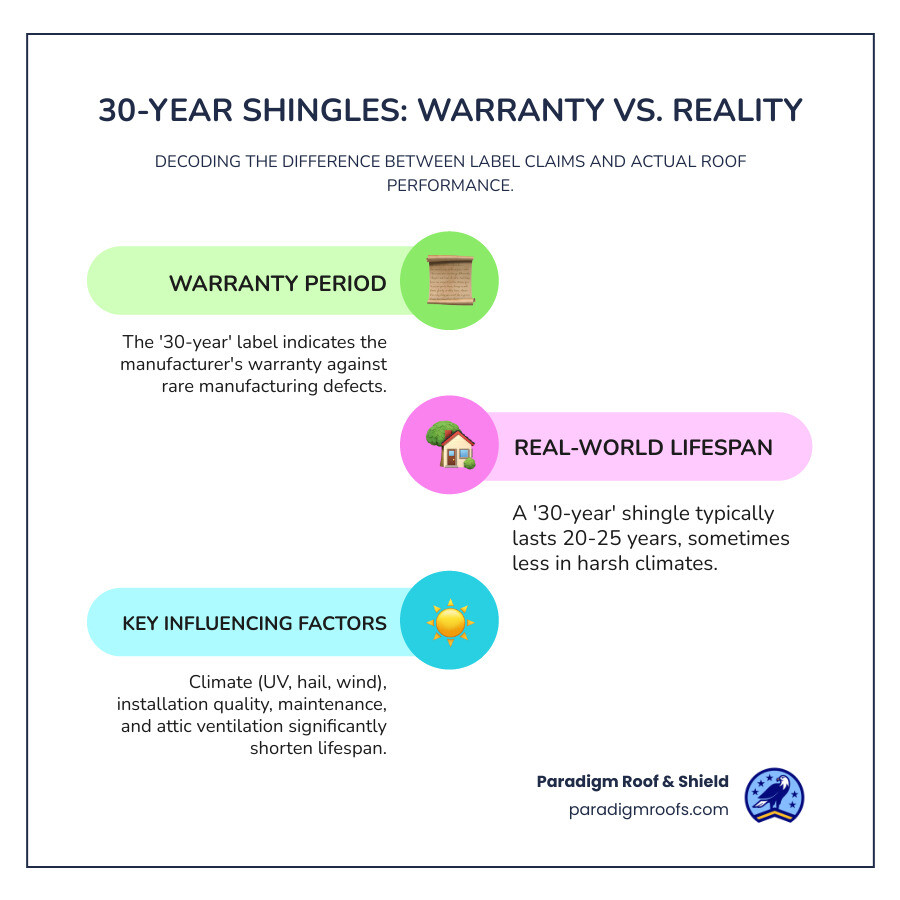
The “30-year” or “25-year” label on a shingle package is a warranty indicator, not a guarantee of service life. In practice, a “30-year” shingle typically lasts 20-25 years, and sometimes less if not properly maintained. This discrepancy arises from factors not covered by the warranty, such as weather, installation quality, and attic ventilation. Manufacturer warranties primarily protect against rare manufacturing defects.
When we talk about “30-year shingles,” what we’re really discussing is the length of the manufacturer’s warranty against manufacturing defects. It’s a common misconception that this number represents the actual lifespan of the roof. While it sounds reassuring to think your roof will perform flawlessly for three decades, the truth is a bit more nuanced, especially in diverse climates like McKinney, Houston, or Neptune Beach.
For example, in a region like Florida, where we serve homeowners in Neptune Beach, architectural asphalt shingles are often rated for 30 years but typically last for 20-25 years on average. This is due to the intense sun, humidity, and the occasional hurricane that can significantly reduce a shingle’s life expectancy. The “30-year” designation simply means the manufacturer will cover manufacturing defects for that duration, not that the shingle is impervious to the relentless forces of nature. The actual performance, or “real-world lifespan,” is a different story.
Many factors beyond the manufacturer’s control come into play. These include the severity of local weather exposure, the quality of the initial installation, and how diligently the roof is maintained over the years. A comprehensive guide on roof life expectancy can shed more light on these variables. While your warranty is a valuable safety net against faulty materials, it won’t shield you from the effects of extreme weather or a subpar installation.
A Closer Look at 30-Year Shingles vs. Other Options
Not all shingles are created equal. The lifespan rating reflects the shingle’s quality, thickness, and durability. Understanding the physical differences between 25-year and 30-year shingles is crucial for making the right choice for your home and budget.
When homeowners consider a new roof, they often encounter a bewildering array of choices, from 20-year 3-tab shingles to 50-year architectural options. The 30-year shingle has emerged as a popular middle ground, offering a significant upgrade from basic options without the premium price tag of a 50-year product. But what truly sets them apart?
Material, Thickness, and Durability
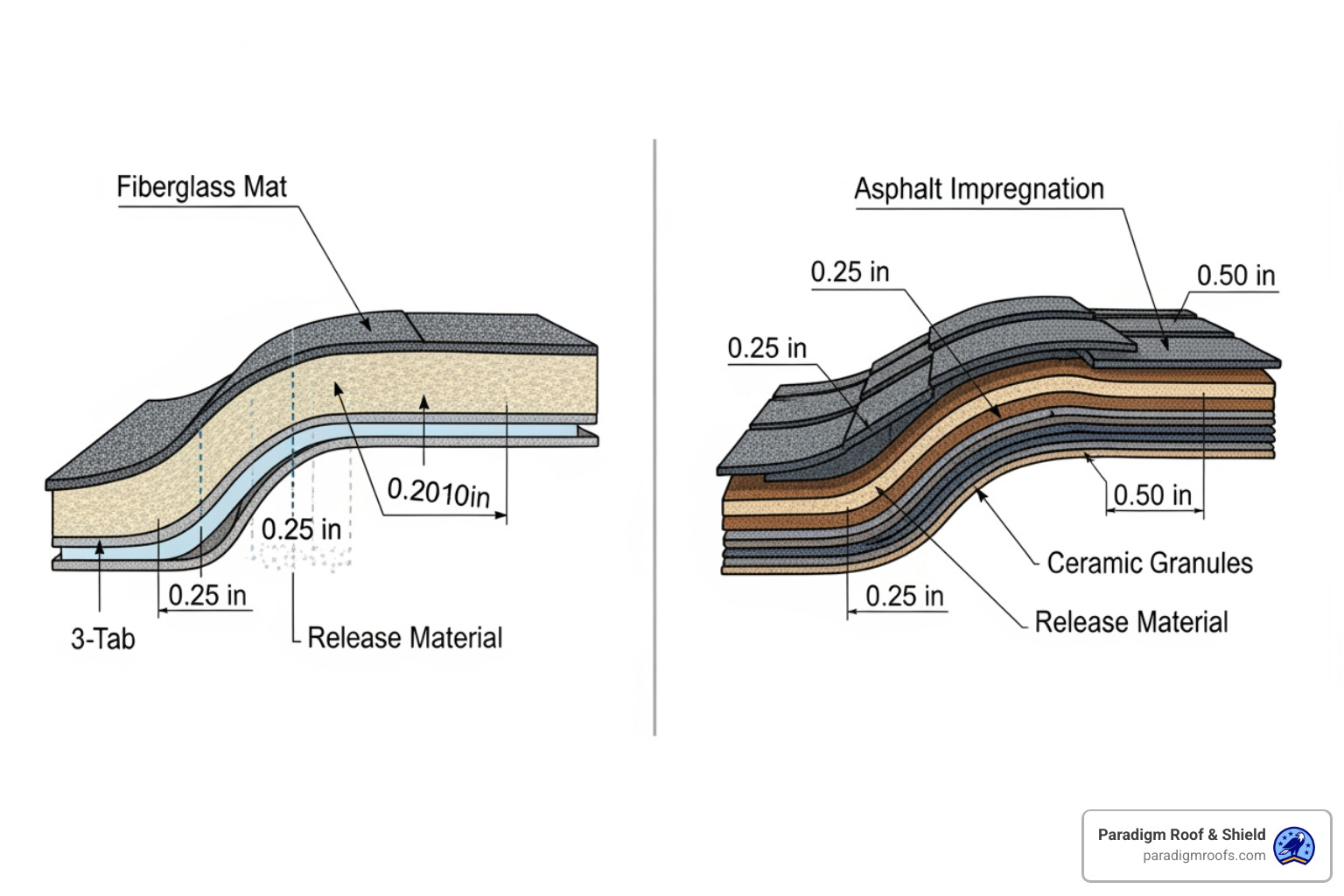
The main difference between shingle ratings is their construction. Basic 25-year shingles are usually single-layer “3-tab” products. These are the classic, flat shingles that have been around for decades, known for their affordability. However, they are thinner and generally less durable.
In contrast, 30-year shingles are almost always architectural or dimensional shingles. These are a different breed entirely. Unlike 3-tab shingles, architectural shingles are multi-layered, creating a thicker, more robust product. This added thickness and layered construction contribute significantly to their durability, making them much heavier and more resistant to common roofing foes like wind uplift and hail impact. They are specifically engineered to offer superior performance and a longer service life than their 3-tab counterparts.
For context, 3-tab asphalt shingles typically come with a 20 or 25-year warranty, while architectural shingles have historically been rated as 30, 40, or 50-year products. This distinction isn’t just about marketing; it reflects a tangible difference in material quality and structural integrity.
Cost vs. Long-Term Value
While 30-year shingles have a higher upfront cost than basic 3-tab options, they deliver better long-term value. We’ve seen that for an average-sized roof (around 2,500 square feet), the installation of 30-year shingles can range from $20,000 to $30,000. This is a significant investment, but it’s one that often pays dividends over time.
Consider the extended lifespan and reduced frequency of repairs that come with a more durable shingle. While a 3-tab roof might need replacement sooner, leading to another full-scale roof project in a shorter timeframe, a 30-year shingle roof provides a longer period of worry-free protection. This often translates to a lower cost per year of service, making it a more cost-effective choice in the long run. When deciding, it’s wise to consider not just the immediate expense but also how long you plan to stay in your home. For a deeper dive into financial considerations, our article on Should You Repair or Replace Your Roof? offers valuable insights.
Aesthetic Appeal and Home Value
Architectural 30-year shingles provide a significant aesthetic upgrade over flat 3-tab shingles. Their dimensional, textured appearance adds depth and character to your roof, mimicking the look of more expensive roofing materials like cedar shakes or natural slate. This improved visual appeal can dramatically boost your home’s curb appeal, making it stand out in the neighborhood.
Beyond just looking good, this aesthetic upgrade directly translates to an increase in your property’s resale value. Potential buyers often perceive a home with architectural shingles as better maintained and more modern, which can be a deciding factor in a competitive market. For homeowners in McKinney, Houston, or Neptune Beach looking to improve their property, architectural 30-year shingles offer a perfect blend of durability and design sophistication.
Key Factors That Determine Your Roof’s Actual Lifespan
A shingle’s rating is only a starting point. Several external factors have a much greater impact on how long your roof will actually last. From intense sun to improper installation, these elements can significantly shorten a roof’s life.
When we install a roof, we’re not just putting shingles on; we’re building a system designed to withstand the unique challenges of your environment. Understanding these challenges is key to ensuring your roof lives up to its potential, regardless of its “year” rating.
The Impact of Climate and Weather
Local climate is undeniably the most significant factor affecting shingle longevity. Our service areas, including McKinney, Houston, and Neptune Beach, experience a wide range of weather conditions that can be particularly harsh on roofing materials. Intense UV radiation from the Texas and Florida sun causes asphalt to break down and granules to shed prematurely. High winds, common during thunderstorms or tropical systems, can lift and tear shingles. And, of course, hail can cause immediate, visible damage.
For example, while a 30-year shingle in a mild, temperate climate might realistically last 25 years, the same shingle in the relentless Texas heat and occasional severe storms might only see 18-22 years of service. In Florida, even architectural asphalt shingles, designed for durability, average 20-25 years. This highlights why choosing the right material, specifically engineered for your region’s climate, is absolutely critical. We’ve compiled more insights on this in our guide to The Best Types of Roofing Material for the Dallas-Fort Worth Area Climate, which includes McKinney.
The Critical Role of Installation and Maintenance
Even the highest quality 30-year shingles won’t perform as expected without proper installation. Think of it like this: you wouldn’t buy a luxury car and then have it serviced by an amateur, would you? The same principle applies to your roof. Improper nailing, inadequate attic ventilation, or incorrect flashing can lead to premature failure, leaks, and, critically, can void your manufacturer’s warranty. This is where professional expertise truly shines.
At Paradigm Roof & Shield, we emphasize that a roof is a complete system. This means not just the shingles themselves, but also the underlayment, proper ventilation, starter strips, and ridge caps. Each component plays a vital role in protecting your home. Hiring a certified, experienced contractor ensures that every part of this system is installed according to manufacturer specifications and local building codes. This meticulous approach is the best way to maximize your roof’s lifespan and ensure it provides the protection you expect.
We offer more information about our shingle roofing services and our commitment to technical excellence.
Here’s a list of essential roof maintenance tasks we recommend to extend your roof’s life:
- Regularly clean gutters and downspouts to prevent water buildup.
- Trim overhanging tree branches to prevent debris accumulation and abrasion.
- Inspect your roof periodically for missing, cracked, or curling shingles.
- Check for signs of granule loss, especially after severe weather.
- Ensure attic ventilation is clear and unobstructed to prevent heat and moisture buildup.
- Address any small repairs promptly to prevent them from escalating.
Understanding Your Shingle Warranty
The warranty isn’t just a piece of paper; it’s a legal document with specific terms and conditions. For 30-year shingles, this typically means a “limited lifetime warranty” for the original homeowner, covering manufacturing defects. However, the term “lifetime” can be a bit of a chameleon. It usually means for as long as you own your home, but it often converts to a shorter, transferable warranty (e.g., 50 years) if the property is sold.
Most warranties are “prorated,” meaning that while they might offer 100% coverage for materials for an initial period (often 10 years), the coverage gradually decreases over the remaining years. So, if a manufacturing defect appears in year 20 of a 30-year warranty, you might only receive a fraction of the material cost, and rarely the labor cost for replacement after the initial full coverage period.
Crucially, these warranties typically exclude damage from external factors like severe weather (hail, wind, hurricanes), improper installation, lack of maintenance, or structural movement. This is why the distinction between a manufacturing defect and damage caused by environmental factors or poor workmanship is so important. Always, always read the fine print to understand what is and isn’t covered. An example of a shingle warranty document can illustrate just how detailed these documents can be. It’s a bit like reading ancient hieroglyphs, but understanding it can save you a lot of grief (and money!) down the line.
Frequently Asked Questions about Shingle Lifespans
We get a lot of questions from homeowners in McKinney, Houston, and Neptune Beach about shingle lifespans. Here are some of the most common ones:
Are 30-year shingles better than 25-year shingles?
Quick Answer: Yes, generally.
Explanation: When we refer to “25-year shingles,” we are typically talking about traditional 3-tab asphalt shingles. In contrast, 30-year shingles are almost exclusively architectural or dimensional shingles. The differences are significant:
- Thickness: 30-year shingles are thicker due to their multi-layered construction. This makes them more robust.
- Durability: Their added mass and design provide superior resistance to wind uplift, hail impact, and general wear and tear compared to thinner 3-tab shingles.
- Aesthetics: Architectural shingles offer a more appealing, dimensional look that mimics natural materials, enhancing your home’s curb appeal.
- Service Life: While the warranty is for 30 years, their robust construction means they tend to last longer in real-world conditions than 25-year 3-tab shingles.
For these reasons, 30-year architectural shingles represent a clear upgrade in both performance and appearance.
Can my 30-year shingles really last 30 years?
Quick Answer: No, not usually in real-world conditions.
Explanation: This is one of the biggest misconceptions in roofing. The “30-year” label refers to the manufacturer’s warranty period for manufacturing defects, not a guarantee of how long the shingles will physically endure on your roof. In most real-world conditions across the United States, a properly installed and maintained 30-year shingle roof will realistically last between 20 and 25 years.
In harsh climates like Houston or Neptune Beach, with intense sun, high humidity, and the potential for severe weather events like hurricanes and hailstorms, this lifespan can be even shorter, perhaps 18-22 years. The sun’s UV rays relentlessly break down the asphalt, causing granules to shed, while temperature fluctuations lead to expansion and contraction that can cause cracking. So, while we certainly aim for longevity, a full 30 years is more of an ideal scenario than a typical outcome.
When should I choose 30-year shingles over other options?
Quick Answer: 30-year shingles are an excellent choice when you want a significant upgrade in durability and aesthetics from basic 3-tab shingles, but need to remain within a sensible budget, offering a fantastic balance of value and performance.
Explanation: We often recommend 30-year architectural shingles for homeowners who:
- Seek improved durability: If you live in an area prone to moderate winds or hail, the added thickness and layered construction offer better protection than 3-tab shingles.
- Desire improved curb appeal: The dimensional look significantly improves your home’s aesthetic, which can be a key factor if you’re planning to sell in the next 10-15 years or simply want a more attractive home.
- Prioritize long-term value: While more expensive upfront than 3-tab, their longer real-world lifespan and reduced maintenance needs often make them more cost-effective over a 20-25 year period.
- Have a mid-range budget: They provide a substantial upgrade from 3-tab shingles without the significant cost jump to 40- or 50-year premium options or other roofing materials like metal or tile.
If you’re planning to stay in your home for at least 15-20 years, 30-year shingles offer a smart investment that balances upfront cost with lasting performance and beauty.
Get the Real Deal for Your Roof
The “30-year” label on a shingle is a quality grade, not a performance guarantee. The true lifespan of your roof depends on selecting the right material for your climate and ensuring expert installation. At Paradigm Roof & Shield, we believe in transparency and technical excellence. Our veteran-led team brings craftsmanship and integrity to every project, ensuring your shingle roof replacement is built to last, providing your home in McKinney TX, Houston TX, or Neptune Beach FL with the robust protection it deserves.
Ready to invest in a roof that truly protects your home? Explore our shingle roofing options or call us at (817) 542-7723 for a comprehensive consultation. We’re here to help you make an informed decision for your most important asset.