


45 Mil TPO Roofing: The Definitive Guide for Property Owners
45 mil tpo roofing is a thermoplastic polyolefin single-ply membrane widely used for commercial and residential low-slope roofs. As a leading provider of expert roofing solutions, we’ve seen this material become one of the most popular choices in the commercial roofing industry due to its balance of affordability, durability, and energy efficiency.
Quick Answer: What is 45 Mil TPO Roofing?
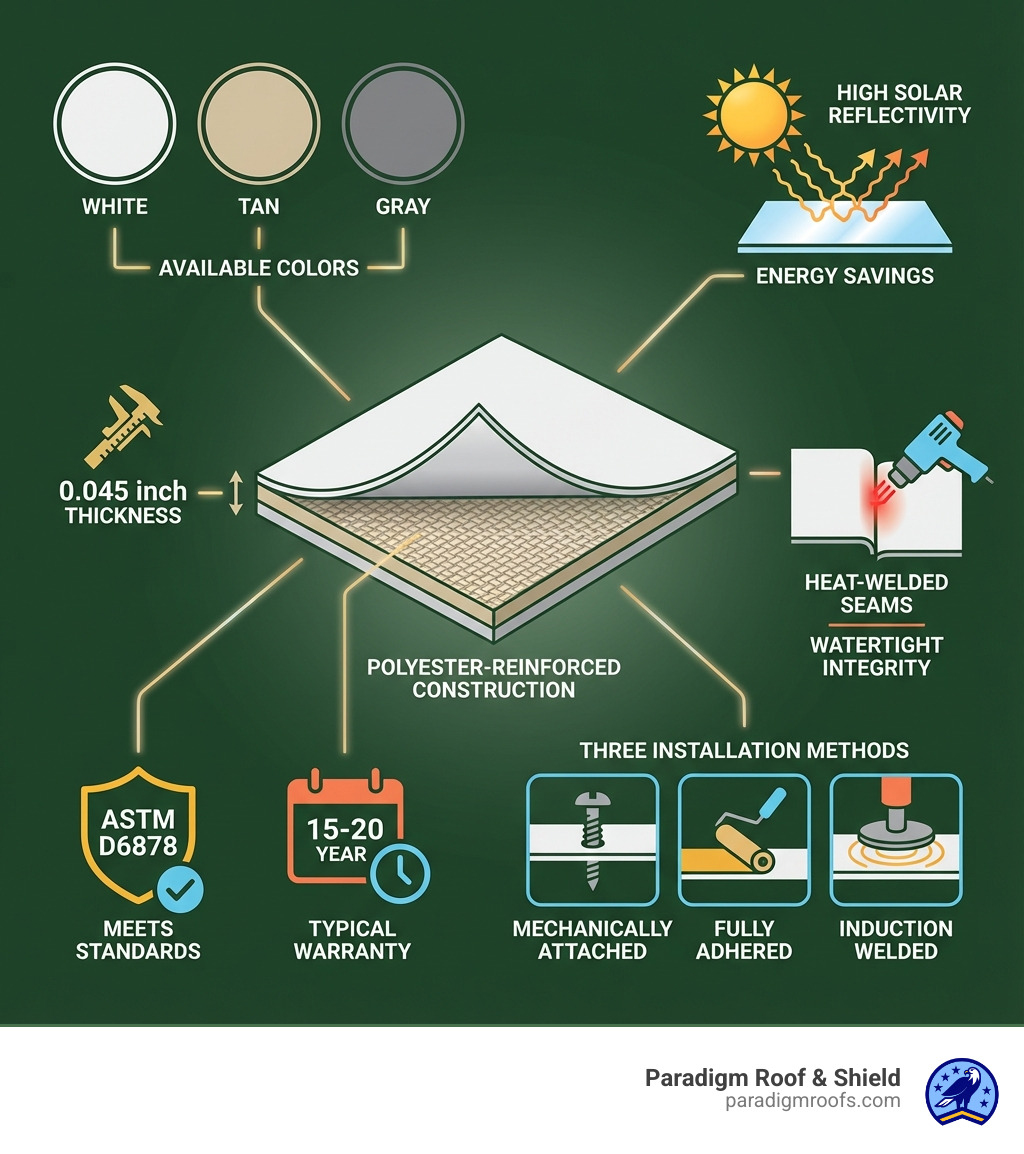
- Material: Thermoplastic polyolefin membrane reinforced with polyester fabric
- Thickness: 0.045 inches (nominal)
- Primary Use: Low-slope and flat roofs on commercial buildings, industrial facilities, and some residential applications
- Key Benefits: Heat-welded seams, high reflectivity, UV resistance, and fungal resistance
- Installation Methods: Mechanically attached, fully adhered, or induction welded
- Typical Warranty: 15-20 years for 45 mil thickness
- Cost Position: Most budget-friendly TPO thickness option
The TPO market was valued at USD 4.57 billion in 2021, with thermoplastic membranes seeing a 14% growth over the prior year. Major manufacturers like GAF have sold more than 6 billion square feet of TPO membrane, with formulations remaining unchanged for over 20 years.
Whether you’re managing a commercial property, planning new construction, or replacing an aging roof, understanding 45 mil TPO helps you make informed decisions about your roofing investment. The material meets rigorous ASTM D6878 standards for thickness, tearing strength, breaking strength, and weather resistance.
If you’re considering commercial TPO roofing for your property, understand not just the material itself, but also how installation methods, system components, and maintenance practices affect long-term performance.
What is 45 Mil TPO? A Breakdown of Its Uses & Composition
At its core, 45 mil tpo roofing refers to a single-ply thermoplastic polyolefin membrane that is 0.045 inches thick. This specific thickness is the entry-level option for TPO membranes, offering a cost-effective yet robust solution for various roofing needs.
Primary Applications and Uses
The versatility of 45 mil tpo roofing makes it suitable for a broad spectrum of projects, particularly those involving low-slope or flat roofs.
- Commercial Properties: From retail centers and warehouses to office buildings and industrial facilities in areas like Houston, 45 mil TPO provides a durable, energy-efficient solution. Its heat-welded seams create strong, monolithic bonds crucial for large commercial footprints.
- Residential Low-Slope Roofs: While often associated with commercial buildings, 45 mil TPO is also ideal for residential properties with low-slope sections including garage roofs, porch roofs, sunrooms, and carports. For homeowners seeking long-lasting, low-maintenance options, 45 mil tpo roofing offers clear advantages. Explore residential applications here: 45 Mil TPO Roofing Residential.
- New Construction and Roof Replacements: Whether it’s new construction or complete tear-off and replacement, 45 mil TPO’s ease of installation and light weight make it practical for contractors.
- Roof Overlays: In some cases, TPO can be installed over existing roof systems, offering cost-effective re-roofing without extensive tear-off. Learn more: Can TPO Be Installed Over an Existing Roof System?
Core Composition and Industry Standards
The strength and performance of 45 mil tpo roofing come from its unique composition and adherence to strict industry standards.
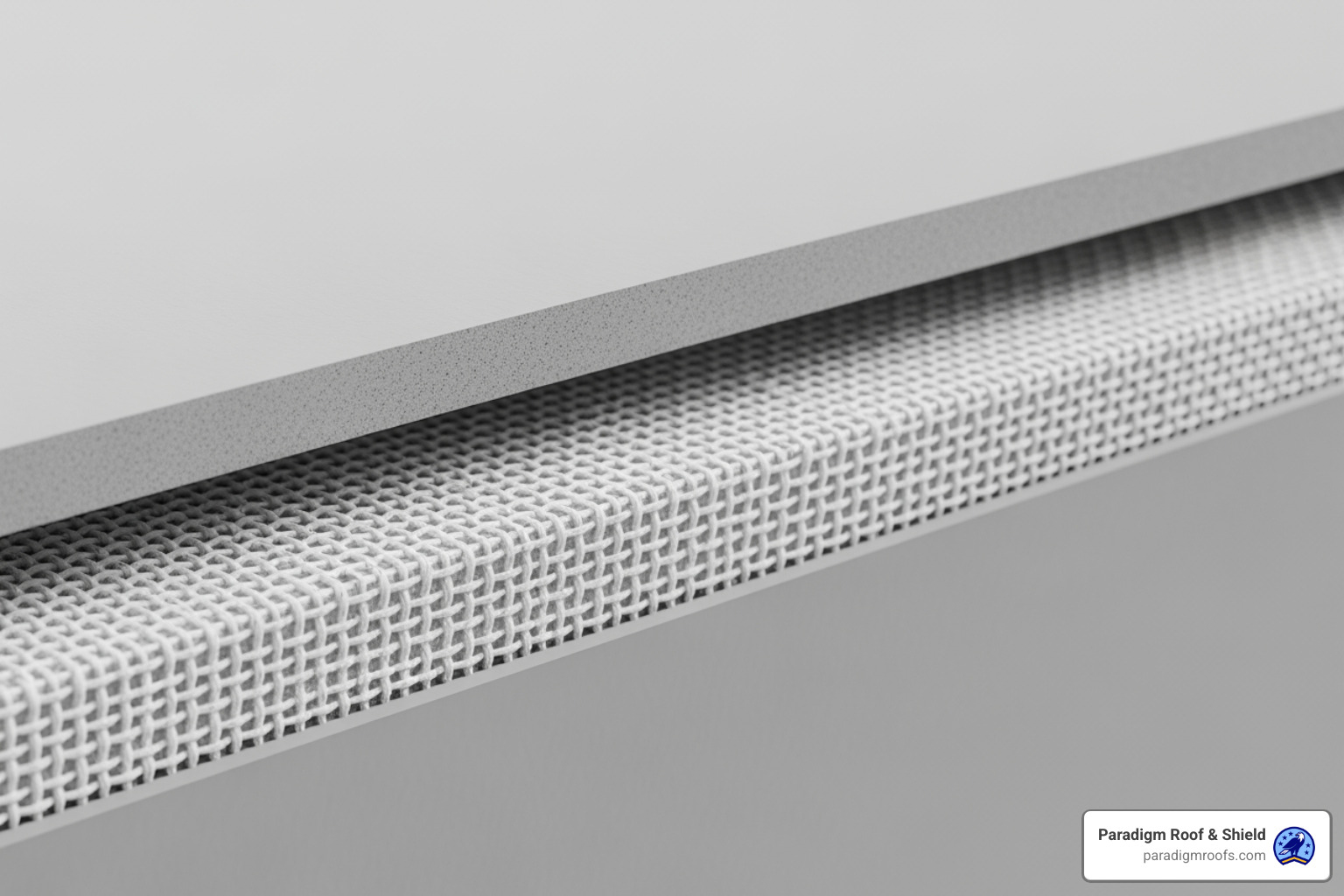
- Polyester-Reinforced Fabric: A polyester fabric scrim provides dimensional stability, flexibility, and weldability, making the membrane resistant to tears and punctures.
- UV-Resistant Formulation: TPO contains built-in ultraviolet inhibitors, eliminating the need for additional UV protectant sprays and ensuring long-term heat and UV stability.
- Heat-Welded Seams: TPO’s ability to be heat-welded creates chemical bonds between membrane sheets, resulting in seams often stronger than the membrane itself.
- Fungal Resistance: Many TPO formulations resist fungal growth without biocides or plasticizers.
- ASTM D6878 Compliance: This key standard ensures quality through testing for thickness over scrim, tearing strength, breaking strength, and heat aging resistance. GAF EverGuard TPO showed no cracking after accelerated heat aging at 275°F for 105 days, while almost every competitor’s sample failed.
Available Colors and Thickness Options
- Standard Colors: White (most popular for energy savings), gray, and tan
- Energy-Efficient Colors: White, energy tan, and energy gray offer high reflectivity for reduced cooling costs
- Custom Colors: Some manufacturers like GAF offer custom options, though darker colors reduce energy efficiency
- Other Thicknesses: 60 mil (improved durability, longer warranties) and 80 mil (highest puncture resistance, longest warranties)
The ROI of TPO: Energy Savings and Durability of 45 Mil Systems
Choosing 45 mil tpo roofing offers a suite of advantages that make it a leading solution for low-slope roofs. From its measurable durability to its documented energy efficiency, TPO provides a high-value return on investment for property owners who need predictable performance over 15–20 years.
Superior Durability and Performance
Despite being the thinnest standard TPO option, 45 mil membranes are engineered for notable resilience.
- Heat-Welded Seams: The heat-welding process creates a chemical bond between sheets, resulting in seams that are extremely strong and watertight. This eliminates much of the vulnerability associated with adhesive-dependent seams. Independent testing has shown that GAF EverGuard® TPO exhibited no cracking after accelerated heat aging, while nearly all competing samples failed, underscoring the strength of the membrane and the integrity of its seams.
- Flexibility in Cold Temperatures: TPO membranes maintain flexibility in colder conditions, which is crucial for preventing cracking and allowing the roof to accommodate thermal expansion and contraction. This behavior supports performance in regions with temperature swings, such as parts of Texas.
- Puncture and Tear Resistance: The polyester reinforcement within the membrane delivers resistance against punctures and tears. While thicker membranes offer greater resistance, 45 mil TPO remains suitable for many common applications, particularly when paired with appropriate underlayment and careful installation.
- Long-Term Weathering: TPO is designed to withstand harsh weather conditions, including UV radiation, temperature extremes, and precipitation. Its formulation incorporates UV inhibitors that guard against degradation from sunlight.
- Proven Performance: GAF’s TPO membrane construction has remained fundamentally unchanged for more than 20 years, with more than 6 billion square feet sold. This consistency in formulation is widely referenced as evidence that modern TPO is a mature and reliable roofing technology.
Significant Energy Savings and Sustainability
One of the most studied benefits of 45 mil tpo roofing, especially in white, is its contribution to energy efficiency and sustainability.
- Cool Roof Technology: White TPO membranes function as “cool roofs” because of their high solar reflectivity. They reflect a large share of solar energy rather than absorbing it as heat. For example, white IKO InnoviTPO has initial solar reflectance values of 0.78 and an initial Solar Reflectance Index (SRI) of 97, meeting widely accepted industry radiative performance benchmarks.
- Reduced Urban Heat Island Effect: By reflecting solar radiation, TPO roofs help mitigate the urban heat island effect, where dense urban areas register higher temperatures than nearby rural zones. This benefits both individual buildings and the broader community.
- Lower Cooling Costs: For buildings in warm climates like Houston, McKinney, and Neptune Beach, a highly reflective white TPO roof can reduce rooftop surface temperatures and lessen HVAC loads. Building owners frequently report meaningful utility savings during cooling seasons when switching from dark roofs to white TPO.
- LEED Credits: Many TPO products, including IKO InnoviTPO, can contribute to LEED (Leadership in Energy and Environmental Design) design credits for energy optimization and heat island reduction. This makes 45 mil tpo roofing a logical choice for projects targeting green building certifications.
- Recycled Content: Some TPO membranes incorporate post-industrial recycled content, improving their environmental profile. For example, JM TPO membranes may contain approximately 5% post-industrial recycled content.
- Halogen-Free Formulation: TPO membranes are typically halogen-free, meaning they do not contain chlorine or other halogenated compounds. This characteristic differentiates them from some older roofing plastics and supports a lower environmental impact profile over the product life cycle.
For more information on the sustainability aspects of TPO and other roofing materials, you can refer to detailed product data sheets like this one: More about sustainable roofing.
A Watertight Seal: TPO Installation Methods & Critical Components
A TPO roof is a complete system, and its performance depends heavily on proper installation and the quality of its components. From the attachment method to the smallest flashing detail, every part contributes to long-term system integrity and watertight performance. At Paradigm Roof & Shield, we emphasize that even the highest quality 45 mil tpo roofing membrane will only perform as well as its installation.
Key Installation Methods for 45 Mil TPO Roofing
The installation method for 45 mil tpo roofing is crucial for its long-term performance and depends on factors like building structure, wind uplift requirements, and budget.
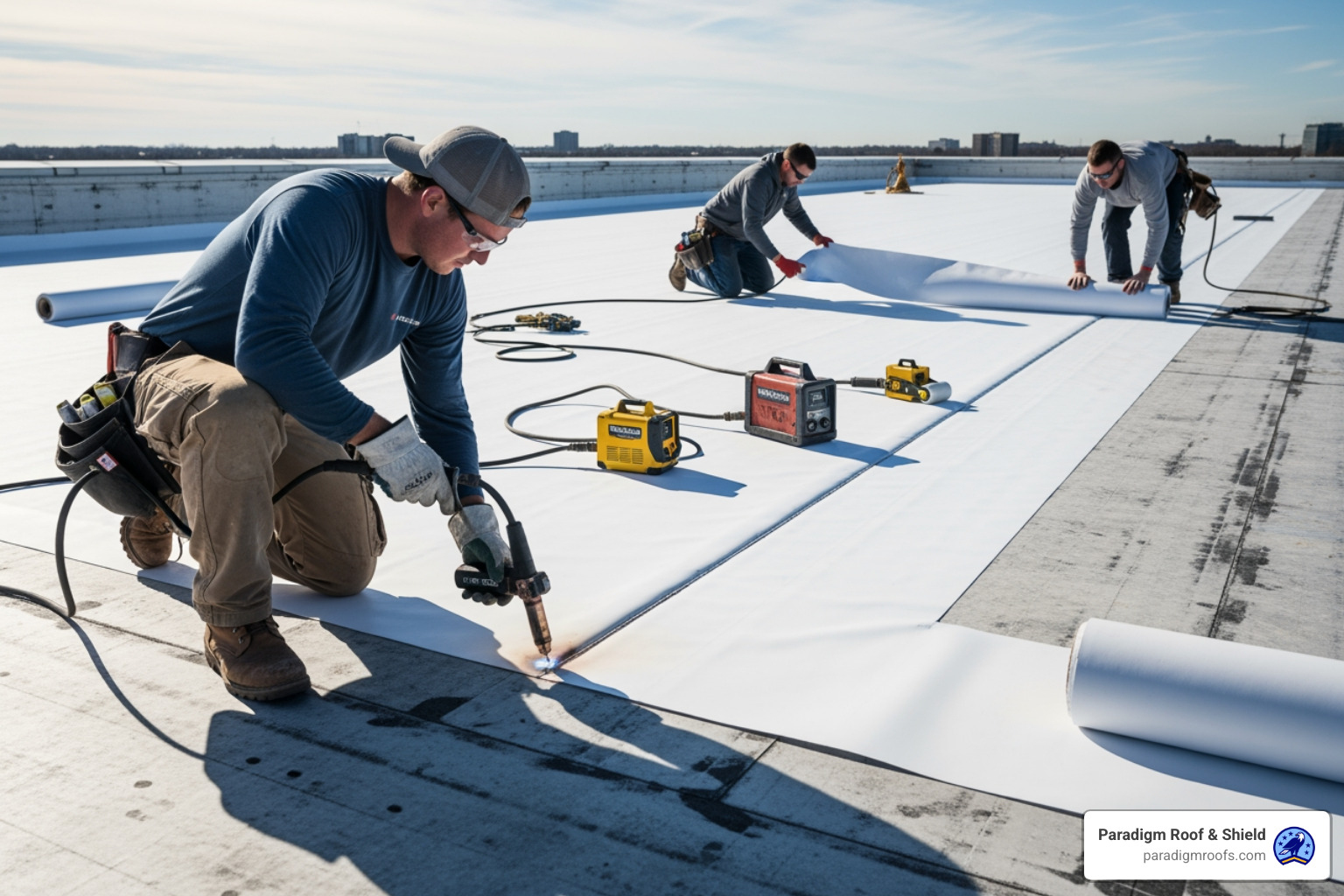
- Mechanically Attached Systems: This is often the most cost-effective and fastest installation method. The TPO membrane is attached to the roof deck using fasteners and plates along the seams. The subsequent membrane sheet is then heat-welded over the fasteners, concealing them. This method is quick and generally has fewer temperature restrictions, making it adaptable for various climates.
- Fully Adhered Systems: In this method, the TPO membrane is fully bonded to the substrate using a specialized adhesive. This creates a smooth, aesthetically pleasing surface and distributes wind uplift pressures evenly across the roof. Fully adhered systems are excellent for roofs where a clean appearance is desired, or where the roof deck cannot accommodate mechanical fasteners. Adhered systems using specific bonding adhesives, like GAF EverGuard® WB181, can also deliver strong wind uplift performance and are suitable for occupied buildings due to low odor. JM TPO-SA (Self-Adhered) membranes can be installed significantly faster than a traditional fully adhered application and require little to no VOCs.
- Induction Welded Systems: This advanced method uses electromagnetic induction welding to bond the TPO membrane to specially coated plates that are mechanically attached to the deck. It is efficient for large areas, reduces labor, and offers high wind uplift resistance. Induction welding systems do not require adhesives, which can be advantageous in certain conditions and allow installation across a wide range of temperatures.
When considering installation, particularly over an existing roof, assess the current roof’s condition and ensure it provides a suitable substrate. You can learn more about this process here: Can TPO Be Installed Over an Existing Roof System?
It is important to note the minimum slope requirements for TPO roofing. The International Building Code® 2018 Edition prescribes a 1/4:12 minimum slope for thermoplastic single-ply membranes in new construction. Positive slope to drain is always required in any roofing project design, whether accomplished through structural slope or the use of tapered insulation. This ensures proper water drainage and limits ponding. For mechanically attached and induction-welded membranes, the maximum slope is typically 4:12 inches (33%), while for ballasted membranes, it is 2:12 inches (16.6%). For fully adhered membranes, there is generally no maximum slope limit.
Essential Accessories and Components
A TPO roofing system is more than just the membrane; it includes a variety of specialized accessories and components that ensure a watertight and durable installation.
- Prefabricated Accessories: These improve installation efficiency and quality. Items like pipe boots, corner flashings, and T-joint patches are factory-fabricated, ensuring consistent quality and reducing field fabrication errors. They can boost productivity and reduce installed costs.
- Pipe Boots: These pre-formed accessories are essential for sealing around pipes, conduits, and other circular penetrations that protrude through the roof.
- Corner Flashings: Used to reinforce and seal internal and external corners, preventing water intrusion at these critical points.
- T-Joint Patches / Cover Tape: These are used to reinforce and seal the T-joints where three sheets of TPO membrane meet, which can be a potential weak point if not properly addressed.
- Walkway Pads: For roofs with anticipated foot traffic, such as those with HVAC units or regular maintenance access, TPO walkway pads provide an extra layer of protection against wear and tear.
- Coated Metal for Edge Details: TPO-coated metal is used to fabricate durable and visually consistent edge details, coping, and fascia. This ensures compatibility and a continuous transition from the membrane to the edge components.
- Vapor Barriers: Depending on the climate and building design, vapor barriers may be installed beneath the TPO membrane to control moisture migration and reduce condensation within the roof assembly. JM Vapor Barrier SA (Self-Adhered) is one example.
- Insulation and Cover Boards: These are critical for thermal performance and protecting the TPO membrane. Products like polyisocyanurate (polyiso) insulation and various cover boards (such as DensDeck or DEXcell) improve energy efficiency, provide a stable substrate, and can improve fire and hail resistance.
- Fasteners and Plates: For mechanically attached systems, specialized fasteners and plates secure the membrane to the roof deck, designed for specific deck types and wind uplift requirements.
45 Mil vs. 60 Mil vs. 80 Mil TPO: A Data-Driven Comparison
Selecting the right membrane thickness is a critical decision that affects durability, warranty, and lifecycle cost. While 45 mil tpo roofing is a popular and cost-effective choice, understanding how it compares to thicker TPO options is essential for long-term planning and for aligning your roof system with the actual demands of your property in places like Houston, McKinney, or Neptune Beach.
45 Mil vs. 60 Mil and 80 Mil TPO
The primary differences between TPO thicknesses are durability, expected lifespan, and cost. The data below summarizes common manufacturer positions on each thickness tier.
| Metric | 45 Mil TPO | 60 Mil TPO | 80 Mil TPO |
|---|---|---|---|
| Thickness | 0.045 inches | 0.060 inches | 0.080 inches |
| Puncture Resistance | Good; suitable for light to moderate traffic | Very good; improved resistance for higher traffic | Excellent; highest resistance, heavy traffic/debris |
| Typical Warranty Length | 15-20 years (e.g., GAF offers up to 20 years) | 20-25 years (e.g., GAF offers up to 25 years) | 25-30 years (e.g., GAF offers up to 30 years) |
| Initial Cost | Lowest among TPO options | Moderate | Highest among TPO options |
| Ideal Application | Budget-conscious projects, light traffic, residential low-slope, re-roofs | General commercial, moderate traffic, improved durability | High-traffic roofs, extreme weather, long-term investment |
Manufacturer guarantee structures, such as those published by GAF for the EverGuard® line, consistently show that guarantees extend as membrane thickness increases, with 45 mil commonly capped at 20 years, 60 mil at 25 years, and 80 mil at 30 years when paired with approved assemblies.
Considerations for Choosing the Right Thickness
When our team at Paradigm Roof & Shield helps you select the appropriate TPO thickness, we consider several key factors that directly affect performance and cost of ownership.
- Project Budget: 45 mil tpo roofing is generally the most budget-friendly option upfront. If initial cost is a primary concern and the roof will not experience heavy traffic or extreme conditions, 45 mil can be a suitable choice.
- Expected Foot Traffic: Roofs with frequent foot traffic for maintenance, equipment servicing, or other purposes benefit from thicker membranes. In many cases, 60 or 80 mil TPO is recommended for surfaces that will see tools, rolling equipment, or repeated access.
- Warranty Requirements: Longer warranties usually require thicker membranes and specific assemblies. If a 25- or 30-year warranty is desired, you will typically need to opt for 60 or 80 mil TPO installed by a certified contractor under a manufacturer-approved specification.
- Climate and Weather Exposure: While 45 mil TPO is durable, roofs in areas prone to severe weather, high winds, or frequent hail can gain added resilience from a thicker membrane and robust cover board. Long-term weatherability studies of 8- to 16-year-old TPO roofs show strong performance across all thicknesses, but added thickness provides a greater margin of safety for impact and wear.
- Long-Term Value: Although 45 mil has the lowest initial cost, a thicker membrane with a longer lifespan might offer better total value by deferring replacement and reducing future repair frequency. For mission-critical commercial assets, many owners treat thicker TPO as a capital investment that stabilizes operating costs over decades.
Maximizing Your Investment: TPO Lifespan, Maintenance, and Warranty
A properly installed TPO roof is a long-term building asset, and its lifespan is maximized through proactive maintenance and a clear understanding of warranty coverage. We at Paradigm Roof & Shield focus on simple, repeatable maintenance practices that keep 45 mil tpo roofing performing at a high level throughout its service life.
Typical Lifespan and Maintenance Needs
The expected service life of 45 mil tpo roofing typically ranges from 15 to 20 years, aligning with common warranty periods for this thickness. With consistent maintenance and favorable conditions, some TPO roofs can surpass their rated service life.
Routine maintenance is straightforward but essential:
- Routine Inspections: Annual or bi-annual inspections, especially after severe weather events, allow minor issues such as loose seams, punctures, or drainage concerns to be corrected before they escalate.
- Cleaning for Reflectivity: To preserve energy efficiency, especially for white TPO, the roof should be kept clean. Dirt, dust, and biological growth reduce solar reflectivity over time. A soft-bristle brush or floor broom and appropriate cleaning agents can be used for routine cleaning.
- Debris Removal: Regularly remove accumulated debris, such as leaves, branches, or trash, which can clog drains, trap moisture, or cause punctures.
- Seam Checks: Pay attention to heat-welded seams. While they are extremely strong when properly welded, minor imperfections can develop. Early detection of lifting or separation enables quick, professional repairs.
- Professional Repairs: If damage occurs, it is important to have a qualified roofing professional perform repairs. TPO is heat-weldable, making repairs efficient and durable when executed with the right equipment and compatible products.
- Drainage Maintenance: Keep roof drains, gutters, and scuppers clear and functioning properly to prevent ponding water, which accelerates wear on any low-slope roof.
By following these simple steps, you can extend the life of your 45 mil tpo roofing system and preserve its performance. We encourage you to see a completed project for an example of long-term installation quality: Dallas TPO Re-Roof.
Understanding Warranty Options
Warranties for 45 mil tpo roofing systems are a central part of the investment decision, providing structured protection against material defects and, in some cases, installation-related failures.
- Manufacturer Warranties: These warranties cover the TPO membrane against manufacturing defects. For 45 mil TPO, typical manufacturer warranties range from 15 to 20 years. GAF, for instance, offers eligible systems up to 20 years for 45 mil TPO. These warranties specify approved installation details, roof assemblies, and sometimes maintenance requirements.
- Labor Warranties: Provided by the roofing contractor, these cover the workmanship of the installation for a defined period. At Paradigm Roof & Shield, our veteran-led team backs its craftsmanship with labor guarantees that complement the manufacturer’s coverage.
- NDL (No Dollar Limit) Warranties: These comprehensive warranties cover both material and labor for qualifying systems over the full term, without a preset cap on repair or replacement costs. They are generally contingent on the system being installed by a certified contractor, using approved components, and often include manufacturer inspections.
- Pro-Rated vs. Full Coverage: It is essential to determine whether a warranty is full coverage for the entire term or pro-rated, where coverage declines over time. While pro-rated warranties are common, NDL warranties provide the most predictable financial protection for owners.
- Certified Installers: Many manufacturers, such as IKO, offer extended warranty protection (for example, IKO Diamond Shield Limited Warranty) when the system is installed by an IAAP Certified Installer and inspected by a manufacturer’s Field Service Technician. This requirement ensures that trained professionals handle the products, which supports both system performance and warranty validity.
Carefully reviewing warranty documents before signing a contract allows building owners to align performance expectations, maintenance obligations, and financial risk over the full life of the TPO roof.
Your Next Step: Is 45 Mil TPO the Right Choice for Your Property?
45 mil tpo roofing delivers a compelling combination of affordability, energy efficiency, and reliable performance, making it a practical choice for many commercial and residential low-slope roofing projects. Its heat-welded seams, flexibility, and documented durability provide a watertight solution that stands up to the elements in diverse climates like those in McKinney, Houston, and Neptune Beach.
By understanding its benefits, ideal applications, and the importance of quality installation, you can make an informed decision that protects your investment for years to come. Whether you are planning a new build, a roof replacement, or need a robust solution for a residential low-slope area, 45 mil TPO stands out as a versatile and high-performing option.
For expert guidance and precise installation, trust the veteran-led team at Paradigm Roof & Shield. Our commitment to craftsmanship, innovation, and integrity ensures your roof is built to last, delivering a durable, energy-efficient roofing system backed by proven best practices.
Ready to explore your options? Contact us today at (817) 562-7663 or learn more about our Commercial TPO Roofing services.