


Aluminium Roof Paint: The Ultimate Guide to Slashing Cooling Costs & Extending Roof Life
Aluminium roof paint is a specialized reflective coating designed to protect and extend the life of commercial and industrial roofs while cutting cooling costs. For property owners comparing options for long-term performance, an aluminium coating is often the most cost-effective way to restore an aging roof without full replacement. When paired with professional commercial roofing services, it transforms your roof from a liability into a durable, energy-efficient asset.
- What it is: A solvent-based bituminous liquid infused with metallic aluminium flakes that forms a bright silver, waterproof barrier
- Key benefit: Reflects up to 63% of solar heat, significantly reducing cooling costs
- Best for: Metal roofs, built-up roofing (BUR), modified bitumen, and concrete surfaces
- Lifespan: 5-10 years with proper application and maintenance
- Main advantages: Superior UV protection, waterproofing, corrosion resistance, and cost-effective roof restoration
If you’re managing a commercial property with an aging metal or built-up roof, this coating offers a proven way to restore performance without the expense of a full replacement. It creates a seamless, reflective shield that protects against weather, reduces surface temperatures, and lasts 2-3 times longer than standard black coatings. For property owners seeking reliable commercial roofing solutions, understanding this product is essential for making informed maintenance decisions.
The challenge many property managers face is choosing between a costly roof replacement and a temporary fix that won’t deliver lasting results. Aluminium roof paint bridges that gap, offering a middle ground that genuinely extends roof life while improving energy efficiency. The metallic coating reflects harsh UV rays that would otherwise degrade your roof membrane, while simultaneously creating a waterproof barrier that seals minor imperfections. This dual action—protection and reflection—is what makes it such a valuable tool in commercial roof maintenance.
I’m Greg Hiltz, CEO of Paradigm Roof+Shield, and over my 15+ years in construction and roofing leadership, I’ve seen how aluminium roof paint transforms aging commercial roofs into high-performing assets. My experience managing complex roofing systems has shown me that the right coating, properly applied, can deliver exceptional returns for property owners who value both performance and cost-effectiveness.
The Science of Aluminium Roof Paint: Composition and Reflectivity Explained
At Paradigm Roof+Shield, we understand that a roof is more than just a cover; it is a critical component of your building’s energy efficiency and structural integrity. That is why we often recommend aluminium roof paint as a powerful solution for commercial and industrial properties in McKinney, Houston, and Neptune Beach.
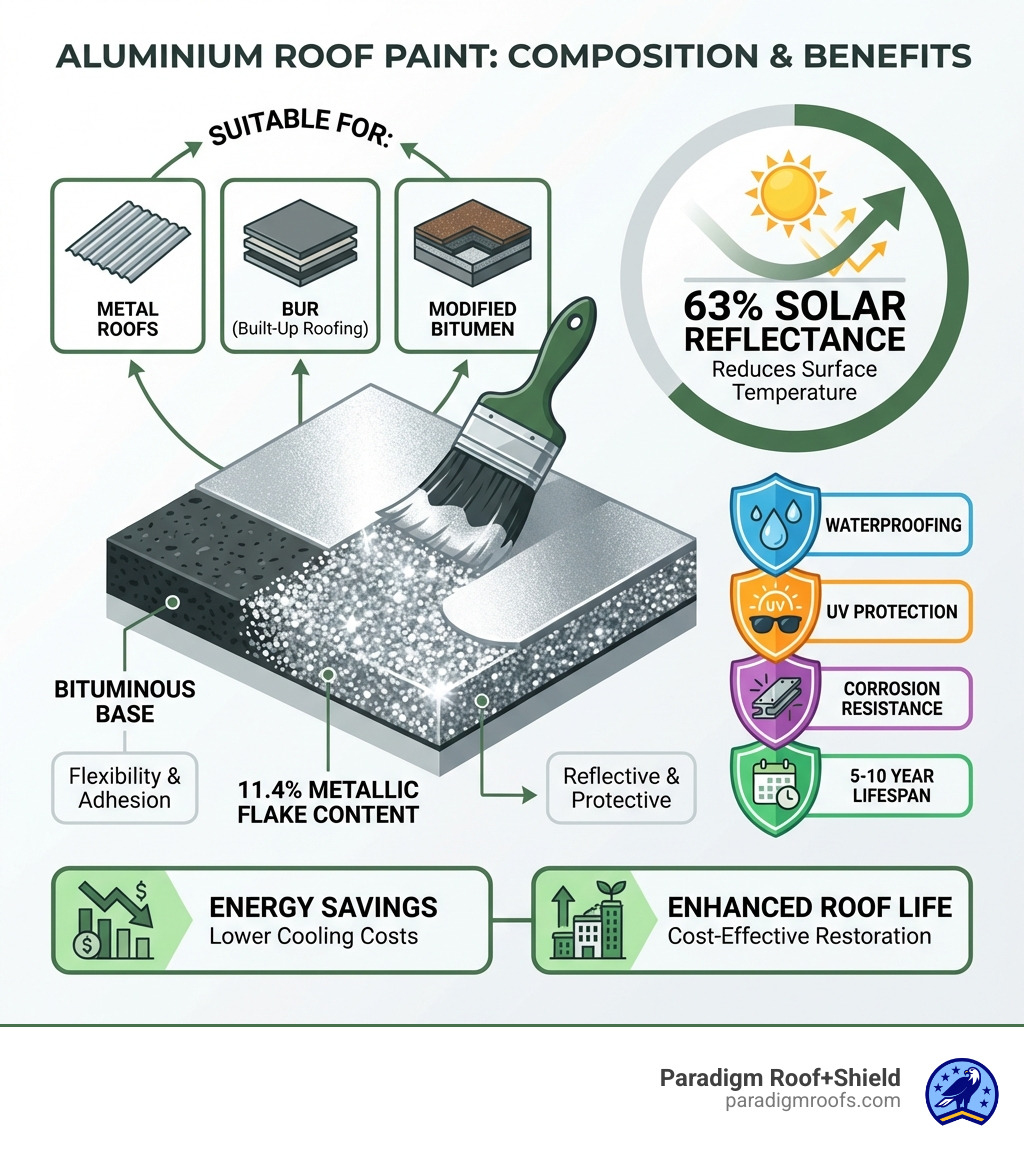
An aluminium roof coating is essentially a sophisticated liquid sealant, typically solvent-based and often with an elastomeric bitumen base. What makes it unique is its infusion with millions of tiny, highly reflective metallic aluminium flakes. Think of it as liquid armor for your roof.
Composition
The primary components of aluminium roof paint include:
- Bitumen Base: Many formulations use an elastomeric bitumen base, which provides flexibility, waterproofing, and excellent adhesion to various roofing substrates. This gives the coating its robust, homogeneous nature.
- Aluminium Pigments: These are the star of the show. The finely milled metallic aluminium flakes are suspended in the base. It is these flakes that are responsible for the paint’s signature silver finish and its reflective properties. High-quality coatings, like some we use, boast a significant metallic flake content, such as 11.4%, which directly contributes to its energy-efficient reflective capabilities.
- Volatile Solvents: These solvents keep the coating in a liquid state for easy application. Once applied, they evaporate, allowing the coating to cure and form a solid, protective film.
Fibered vs. Non-Fibered
You might encounter both fibered and non-fibered aluminium roof coatings. Fibered versions contain small reinforcing fibers that improve the coating’s strength, crack resistance, and durability, making them particularly effective for bridging minor cracks and providing extra reinforcement. Non-fibered coatings offer a smoother finish and are generally used for less demanding applications or as a topcoat over a fibered base.
The Leafing Process and Reflectivity
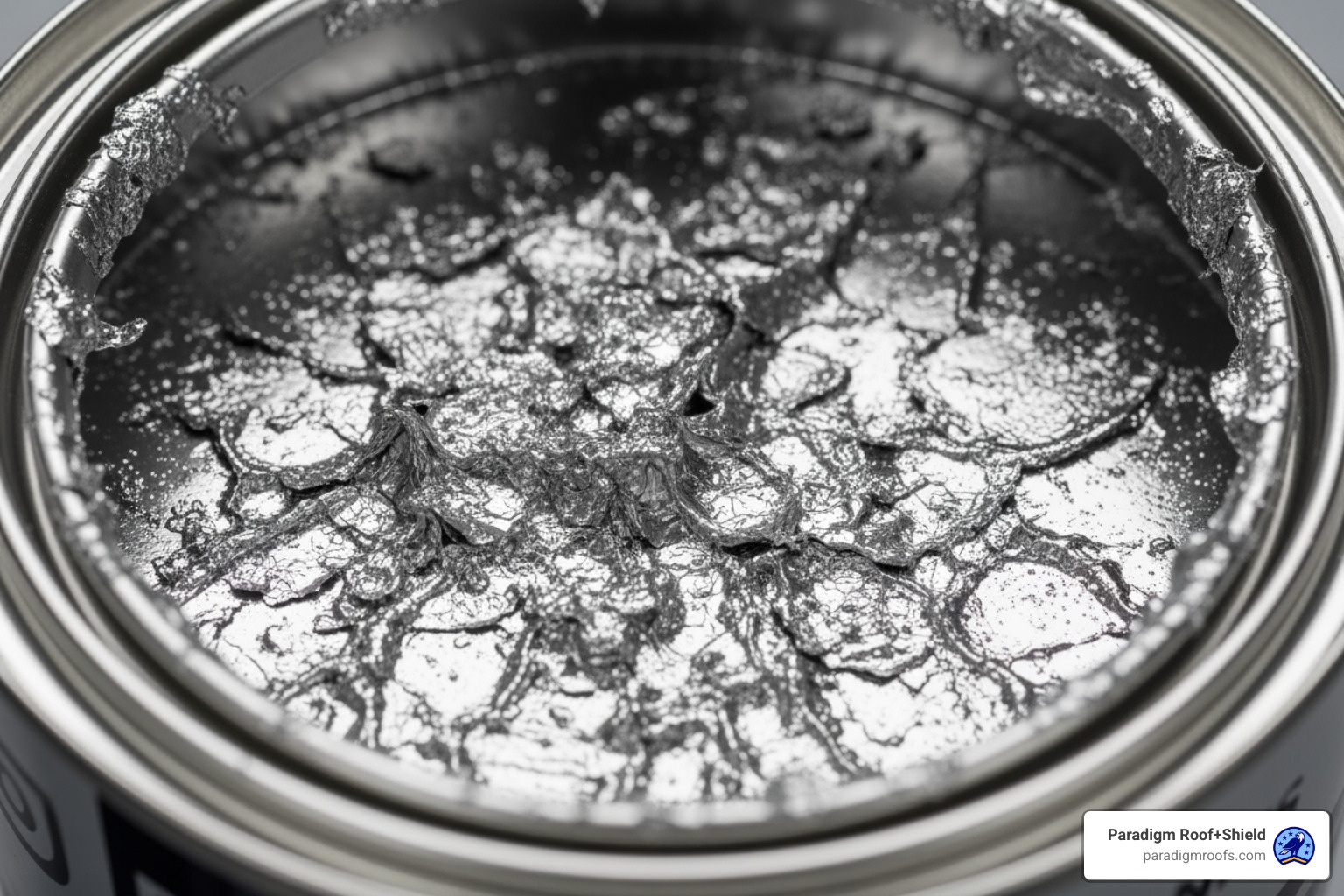
The performance advantage comes from the “leafing” process. After the aluminium roof paint is applied, and as the solvents begin to evaporate, the lightweight aluminium flakes naturally float to the surface of the coating. They then overlap each other, much like tiny scales, forming a continuous, tightly packed, brilliant silver shield.
This metallic barrier does more than improve appearance. It creates a waterproof surface, sealing minor imperfections, and it offers outstanding reflectivity. Quality aluminium roof paint can achieve up to 63% reflectivity, meaning a large share of the sun’s UV and infrared energy is reflected back into the atmosphere rather than absorbed by your roof. Lower rooftop temperatures directly contribute to reduced cooling loads inside the building and measurably slower degradation of the underlying roof system.
5 Data-Backed Benefits of Aluminium Roof Paint for Commercial Properties
Applying an aluminium roof coating is more than just a paint job; it is a strategic upgrade that delivers measurable returns in protection, energy efficiency, and longevity. It is one of the most reliable methods for restoring and preserving commercial and industrial roofs in hot, sunny markets like Texas and Florida.
1. Superior Solar Reflectivity & Energy Savings
The most immediate and impactful benefit of aluminium roof paint is its ability to reflect solar radiation. By bouncing harsh UV rays away from the building, it can lower roof surface temperatures dramatically. Independent tests on quality formulations show reflectivity values up to 63%, driven by metallic flake contents around 11.4%.
This reduction in heat absorption means your air conditioning system works less, leading to noticeable savings on cooling costs during long hot seasons. It effectively reduces the roof surface temperature by reflecting UV rays, which directly contributes to a cooler interior and reduced thermal stress on the roof system.
2. Improved Durability and Lifespan
This coating acts as a shield against the elements. It protects the underlying roof membrane from UV degradation, which is a primary cause of aging, brittleness, and cracking in materials like modified bitumen and built-up roofing (BUR). UV radiation is relentlessly damaging, but aluminium roof paint blocks it and slows oxidation of asphalt-based roofs.
By limiting sun and water damage, it can extend the service life of your roof for years, delaying a costly replacement. Many high-performance coatings are designed to last 2-3 times longer than standard black coatings and maintain flexibility over wide temperature ranges.
3. Excellent Waterproofing and Corrosion Resistance
Aluminium roof paint creates a seamless, waterproof barrier that helps seal minor cracks, pinholes, and seams that might otherwise allow water infiltration. This added layer of protection is valuable for preventing leaks and preserving the structural integrity of the building.
For metal roofs, it provides important protection against rust and corrosion. In humid coastal areas or regions with industrial atmospheres containing mild acid and alkali fumes, the coating forms a barrier that isolates the metal from moisture and corrosive elements, helping steel panels and fasteners last longer.
4. Versatility Across Various Roof Types
While aluminium roof paint is a natural fit for metal roofs, its formulation allows it to bond effectively with several other substrates. It is widely used to restore and protect:
- Built-up Roofing (BUR): Refreshes and protects asphaltic layers from UV and weather.
- Modified Bitumen (SBS & APP): Shields membranes from solar radiation to preserve flexibility and waterproofing capabilities.
- Concrete Surfaces: Adds a reflective and protective layer to concrete roof decks.
- Previously Coated Fibered Aluminium Roofs: Provides a compatible option for maintenance recoats.
This adaptability makes it a versatile choice for many commercial facilities that use different roof systems across multiple buildings.
5. Cost-Effective Roof Restoration
Compared to a full roof replacement, applying an aluminium roof coating is an economical solution for an aging but structurally sound roof. It restores the roof’s performance and appearance at a fraction of the cost, often turning a capital expense into a manageable maintenance project.
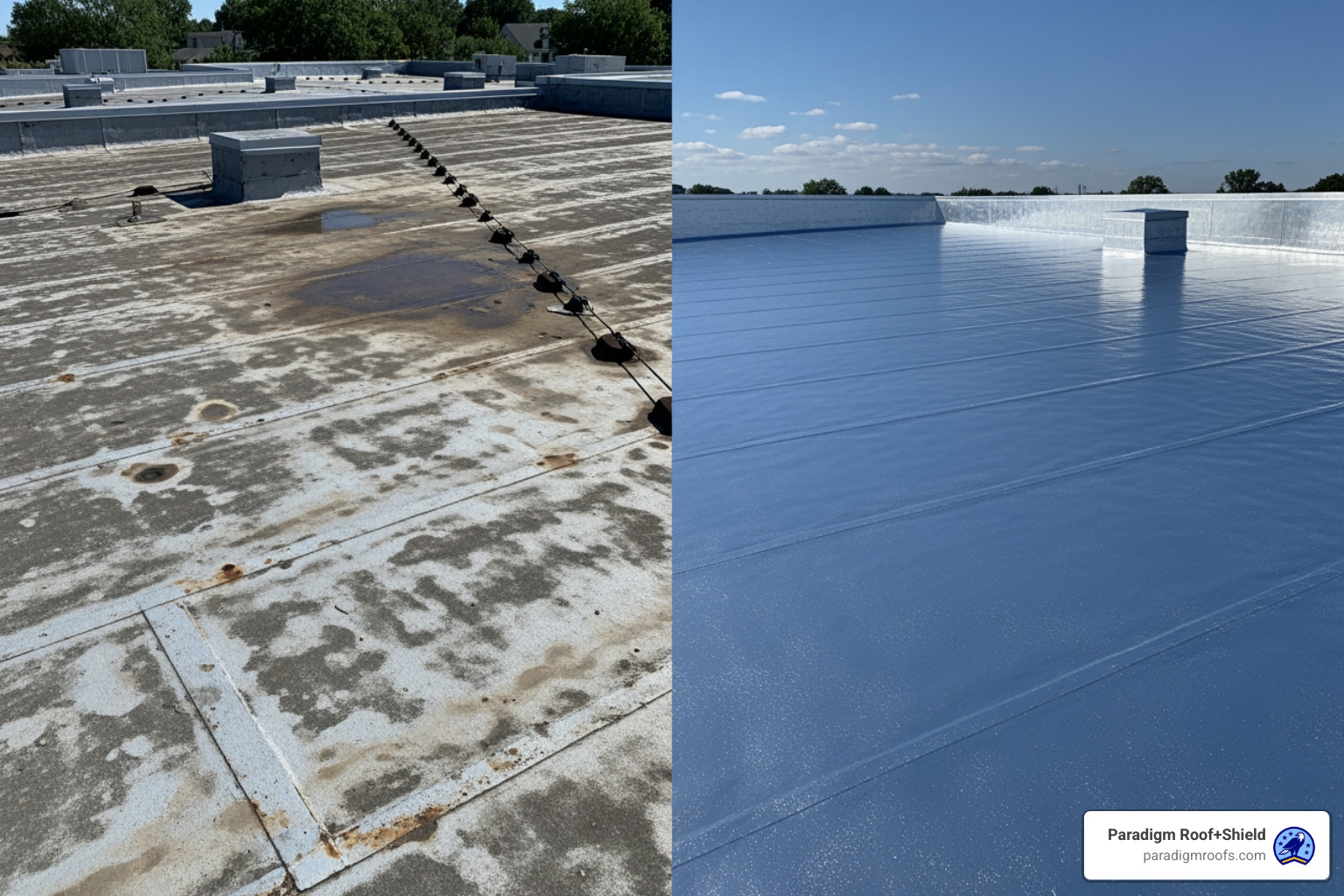
Instead of the disruption and cost of tear-off and replacement, a coating project can revitalize the existing roof, add years of service life, and improve energy performance. That combination of extended life and reduced cooling load is why aluminium coatings are frequently recommended in lifecycle cost analyses.
For owners comparing systems, you can review a detailed breakdown in this guide: Which is better: Elastomeric roof coating or aluminum roof coating?
Professional Application & Maintenance: A Step-by-Step Guide to Aluminium Roof Paint
At Paradigm Roof+Shield, we know that even the best aluminium roof paint only performs as well as its installation. Proper preparation and application are the factors that separate a short-lived coating from a 5–10 year roofing asset.
Suitable Roof Types and Surface Preparation
Before any coating is applied, the roof must be properly prepared. This is the most crucial step for ensuring adhesion and performance and for preventing common issues like peeling or premature wear.
Here are the roofs most suitable for aluminium roof paint:
- Metal (steel, tin, corrugated): Useful for rust-resisting, weatherproofing, and reflecting heat on various metal roof types and sidewalls. Some formulations can bond to tight rust without primer.
- Built-up Roofing (BUR): Appropriate for restoring and protecting aging asphalt-based BUR systems.
- Modified Bitumen (SBS & APP): Extends the life of these membranes by shielding them from UV damage.
- Previously Coated Fibered Aluminium Roofs: Effective for maintenance and recoating existing reflective surfaces.
However, aluminium roof paint is generally not suitable for application over shingles, tar surfaces, slate, tile, or wood.
Surface preparation typically involves:
- Thorough Cleaning: All surfaces must be clean and free from dirt, grease, oil, mold, algae, loose granules, loose paint, rust, excess chalk, and other foreign matter. Contractors commonly use a high-pressure wash of around 2,000 psi to achieve a clean surface.
- Rust and Debris Removal: For metal roofs, any loose rust or flaking paint is wire-brushed, scraped, or pressure washed away.
- Seam and Flashing Repair: Before the topcoat, seams, penetrations, faulty copings, parapet walls, blisters, or surface breaks on BUR/Modified Bitumen roofs should be repaired so the roof is watertight before coating.
- Cure Time for New Asphalt: On newly installed asphalt built-up roofs, manufacturers commonly require 60–90 days of weathering before aluminium roof paint is applied to allow asphalt to cure and off-gas.
Skipping or shortening these steps is the most common reason coatings fail early.
The Application Process for aluminium roof paint
Once the surface is prepared, application of aluminium roof paint should be done in dry weather, with no immediate threat of rain, and within the manufacturer-recommended temperature range, often between 50–110°F (10–43°C). Humidity is usually kept below about 85%, and surface temperature should be at least 5°F (3°C) above the dew point.
- Thorough Mixing: Before and during application, aluminium roof paint must be mixed thoroughly. Metallic flakes settle to the bottom, so mixing keeps them evenly dispersed and is essential for uniform appearance and reflectivity.
- Application Methods:
- Airless Sprayer: For large roofs, airless spray equipment provides an efficient, uniform coat. Professional rigs commonly develop 2,000–3,000 psi at the tip with compatible nozzles.
- Brush or Roller: For smaller areas, edges, or detailing, a brush or 3/8″ nap roller allows more precise control around penetrations and flashings.
- Two-Coat System: Many projects benefit from a two-coat system. The first coat is applied at the specified coverage rate and allowed to dry, often about 24 hours depending on weather, before a second, lighter coat is applied. Layering improves waterproofing and reflectivity.
- Coverage Rates: Coverage varies by substrate and product. Over metal, practical coverage is often around 50 sq. ft. per gallon. Over BUR or modified bitumen, typical coverage may be closer to 40 sq. ft. per gallon because those surfaces are more porous. Manufacturers frequently state coverage around 10 m² per litre under ideal conditions.
- Drying and Curing: Coatings are commonly dry to the touch in several hours and weather resistant in about 24 hours, but full cure usually takes 10–12 days. During full cure, heavy traffic and mechanical work on the roof should be minimized.
Lifespan and Maintenance of your aluminium roof paint
With professional application and regular upkeep, an aluminium-coated roof can provide protection for 5 to 10 years. Lifespan is determined by product quality, the starting condition of the roof, climate, and maintenance practices.
To maximize the life of your aluminium roof paint, it is wise to:
- Schedule Regular Inspections: Inspect at least annually, and after severe storms, to identify small issues before they become failures.
- Remove Debris: Keep the roof clear of leaves, branches, dirt, and standing water. Debris can trap moisture, promote biological growth, and accelerate wear.
- Perform Spot Repairs: Address localized wear, cracking, or delamination promptly. Applying new aluminium roof paint to worn sections can restore performance and postpone the need for a full recoat.
Aluminium vs. Elastomeric: A Data-Driven Comparison of Roof Coatings
While aluminium roof paint is an excellent choice for many applications, property owners should understand its technical specifications and how it compares with alternative coatings before deciding on a long-term system.
What to Look For: Key Specifications
When selecting a product, the technical data sheet is the most important document to review. Key performance indicators include:
- Solids Content: A higher percentage of solids by weight or volume means more actual coating remains on the roof as the solvent evaporates, which usually translates to better durability and coverage per gallon.
- Reflectivity Percentage: For energy savings, reflectivity is critical. Products with solar reflectance of 60% or higher, such as aluminium coatings tested around 63%, reduce heat gain and surface temperatures.
- VOC Content: Volatile Organic Compound (VOC) levels affect safety and environmental impact. Lower VOCs reduce odor and airborne pollutants during application.
- ASTM D2824 Compliance: This standard covers aluminum-pigmented asphalt roof coatings and sets performance and asbestos-free requirements. Many commercial-grade coatings clearly list ASTM D2824 compliance in their Technical Data Sheet.
- Service Temperature Range: The coating should withstand local extremes. Many quality aluminium coatings are rated for service temperatures ranging from well below freezing to around 176°F (80°C) or higher.
Potential Drawbacks and Limitations
Every product has limitations, and aluminium roof paint is not ideal for every roof.
Important constraints include:
- Incompatible Surfaces: It is generally not recommended for shingles, wood, tile, slate, or some tar surfaces. These materials need different systems.
- Solvent Odor: Being solvent-based, these coatings emit a noticeable odor during application and curing, which calls for good ventilation and planning in occupied buildings.
- Flammability During Application: Many aluminium coatings have flash points around the low 100°F (40°C) range. Proper storage, handling, and ignition control are essential during installation.
- Limited Recoat Options with Other Colors: The metallic, waxy surface makes it difficult for many other paints to adhere properly. Changing to a different coating type later usually requires extra surface preparation or specialty primers.
- Temporary Bronzing if Wet Too Soon: If rain falls before the film sets, the surface can bronze temporarily. The appearance often improves as curing completes.
Aluminium vs. Other Roof Coatings
Understanding how aluminium coatings compare with elastomeric and black asphalt options helps clarify the best use case for each system.
| Feature | Aluminium Roof Paint | Elastomeric Coatings (Silicone/Acrylic) | Black Asphalt Coatings |
|---|---|---|---|
| Reflectivity | High (up to ~63%), strong solar reflection | Very High (often 80%+ for white), maximum heat reduction | Very Low, absorbs most solar energy |
| Durability | Good, strong UV defense, corrosion resistance, 5–10+ years | Excellent, highly flexible, long-lasting (often 10–20+ years with upkeep) | Moderate, prone to UV degradation, typical lifespan 2–5 years |
| Cost | Moderate, highly cost-effective for restoration | Higher upfront cost, strong ROI where long-term life and reflectivity matter | Low, but requires frequent reapplication and offers little energy benefit |
| Flexibility | Good, handles minor movement | Excellent, designed to stretch and recover with roof motion | Poor, becomes brittle as it ages |
| Best Use Case | Metal roofs, BUR, modified bitumen, economical restoration | Flat/low-slope roofs needing high reflectivity and long-term protection | Basic waterproofing when energy savings are not a priority |
For property owners who want dark or traditional appearances on metal while still gaining protection, additional resources such as this overview of Black roof coating for metal roof provide detailed system comparisons.
Frequently Asked Questions about Aluminium Roof Paint
How long does aluminium roof paint last?
A professionally applied aluminium roof coating typically lasts between 5 and 10 years. Longevity depends on the coating formulation, thickness, quality of preparation, condition of the substrate, local climate, and maintenance practices. Regular inspections and timely touch-ups help coatings reach the upper end of that range.
Can you paint over an aluminium roof coating?
In most cases, it is not recommended to paint over an aluminium roof coating with a different type of product such as acrylic or silicone. The metallic, waxy surface can prevent proper adhesion and lead to peeling or early failure. For recoating, the standard approach is to clean and prepare the existing aluminium surface and then apply another compatible aluminium roof paint.
Does aluminium roof paint stop leaks?
Aluminium roof paint forms a continuous waterproof film that can seal pinhole leaks, hairline cracks, and minor seam imperfections. It functions as a secondary barrier that strengthens a generally sound roof system. However, it is not a substitute for structural repair. Active leaks caused by damaged decking, large openings, deteriorated flashings, or failed seams need to be repaired before the coating is installed, so the system performs as intended.
Upgrade Your Commercial Roof with Aluminium Coating Today
Aluminium roof paint is a proven solution for extending the life of commercial and industrial roofs while improving building energy performance. Its combination of solar reflectivity, waterproofing, and corrosion resistance delivers value in two measurable ways: lower cooling costs and postponed roof replacement.
By reflecting up to 63% of solar energy, aluminium coatings reduce rooftop temperatures and slow UV-driven degradation of asphalt and metal substrates. Many buildings see coatings last 2–3 times longer than traditional black asphalt products under similar conditions, especially in high-sun climates like McKinney TX, Houston TX, and Neptune Beach FL.
For expert guidance on whether aluminium roof paint is the right choice for your building, trust the veteran-led team at Paradigm Roof+Shield. We combine technical excellence, craftsmanship, and integrity to design coating projects that align with your budget and long-term facility goals.
Ready to improve your roof’s performance, save on energy costs, and extend its lifespan? Learn more about our professional commercial roof coatings and schedule a consultation today. Call us at tel:(888)552-7663.